
Robert Mapplethorpe was a free soul who could achieve the blackest black in his photographs you can’t believe your eyes when you look at them. He has been called one of the most fearless image-makers of the 20th century. His photos are intimate and vulnerable with the sitter often engaging directly with the viewer. They’re lovers, artists, gay men, body builders. He captured flowers, faces, phalluses, and bodies pushed to the limit.
Believe it or not, he grew up Catholic. He assembled sculptures and paints wooden frames. He loved magazines and collage art. He did it all and he mastered it all. He would stare at the glamor magazines in store windows in Manhattan where he lived and worked, bumming around with Patti Smith in Greenwich Village. He had a passionate love affair and lived with the punk rock legend, writer, and poet during the late 60s and into the 70s.
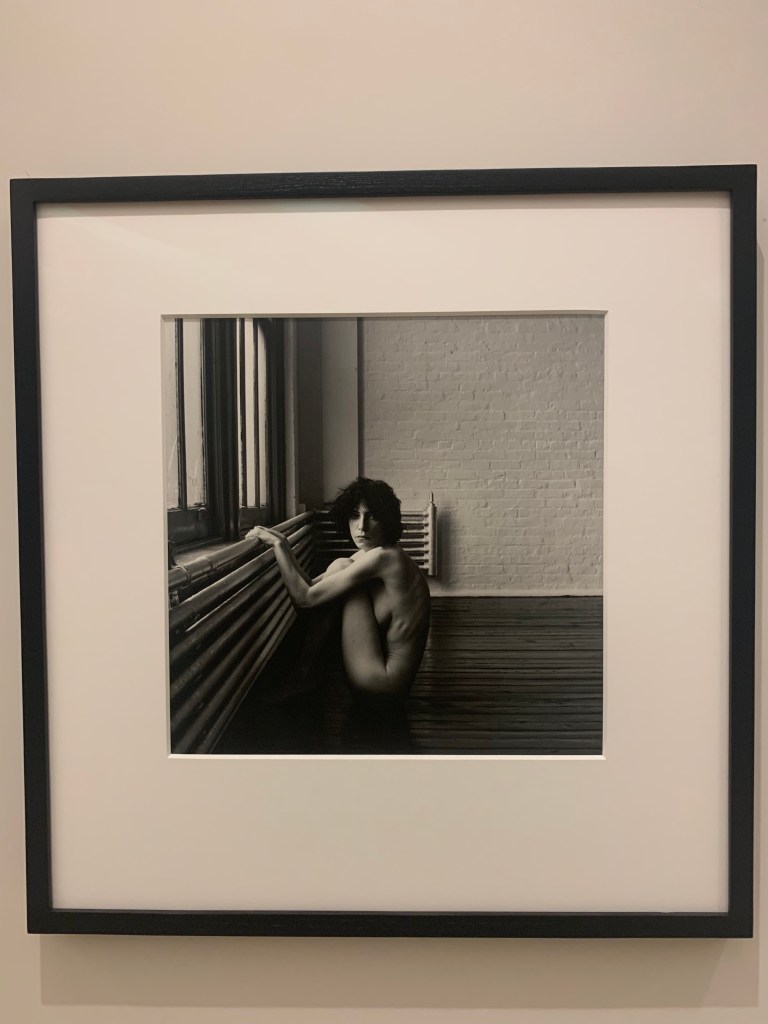
Sadly, Mapplethorpe died due to HIV/AIDS complications in 1989 at the ripe age of 42. He was sexually fluid and involved with numerous men including the famed curator Sam Wagstaff and professor and editor Jack Fritscher. Mapplethorpe was bold and “out there”, but he never really wanted to be shocking. He was no stranger to censorship and protest given the confrontational nature of his work. One famous photo shows the artist from behind bent over at the waist with a butt plug and a trailing whip inserted in his ass. He stares unapologetically, almost intimidatingly out at the viewer as if to ask what are you looking at? There were retrospectives where photos from his so-called X portfolio were contested. At one exhibition, Mapplethorpe was served papers by a dozen policemen who found him guilty of displaying obscenities.
Their frustration simply generates more buzz around the artist and circulates the image to more people. We’re naturally curious about the profane. The taboo.
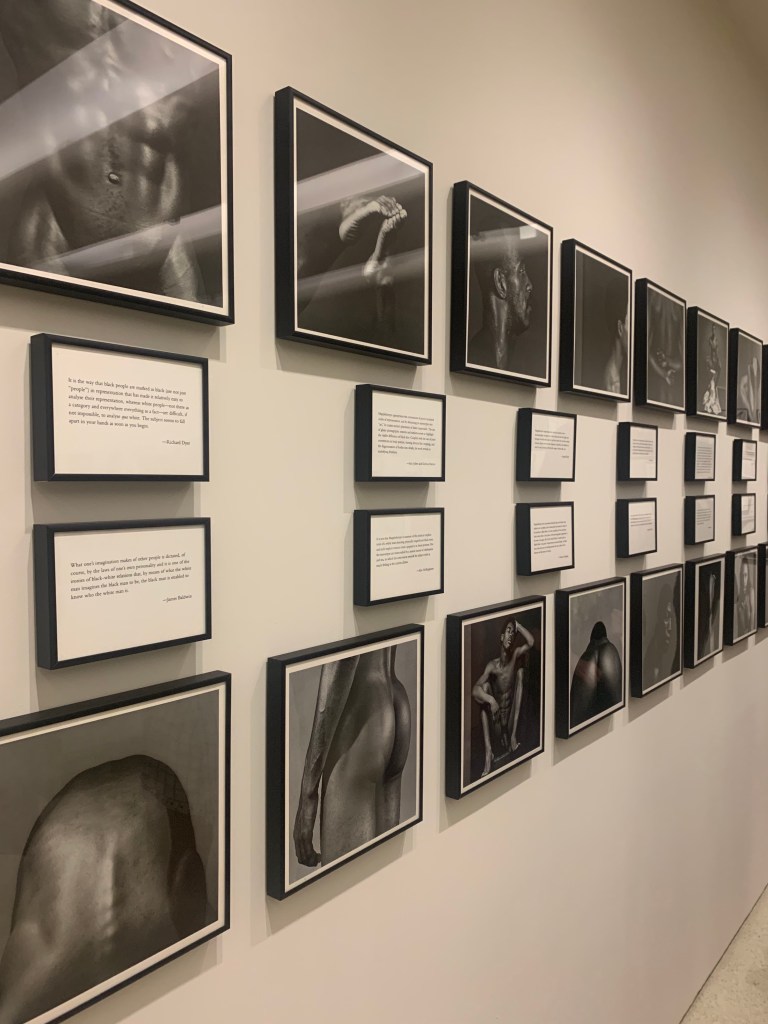
Academics and respected thinkers criticized Mapplethorpe’s depictions of Black men. Some claimed he was exploiting Black men by reducing them only to their genitals and sexuality, reinforcing stereotypes about the significant size of Black men’s genitals, and making these images inherently racist. On the other hand, some say that Mapplethorpe celebrates the Black male form, a body long denigrated in art history. They say that the men’s eye contact with the viewer gives them agency and power. Mapplethorpe himself had intimate personal relationships with some of the models like Ken Moody. His photographs of Moody challenge perceptions of what Black masculinity can be. He photographed Moody nude with flowers and alongside other nude male models.

The curators smartly juxtaposed hand-selected quotes criticizing or praising Mapplethorpe’s work and its relationship with Black men. In three horizontal registers, museum-goers could read framed quotes sandwiched between Mapplethorpe’s photos. It was beautiful and thought-provoking to see. Profound thinkers and writers including bell hooks, Audre Lorde, and model Ken Moody himself weighed in on the photography.
Despite the criticism, Mapplethorpe was confident in himself and his artistic self-expression. He often photographed himself in drag with make-up and costume. When I visited the two-part Implicit Tensions: Mapplethorpe Now at the Guggenheim Museum, I was excited to see the below two self portraits exhibited next to each other. They communicate with each other as much as they do with the viewer. They were situated at the start of the exhibition as if they were greeting visitors on their way in. The juxtaposition speaks volumes to Mapplethorpe’s gender performance too.
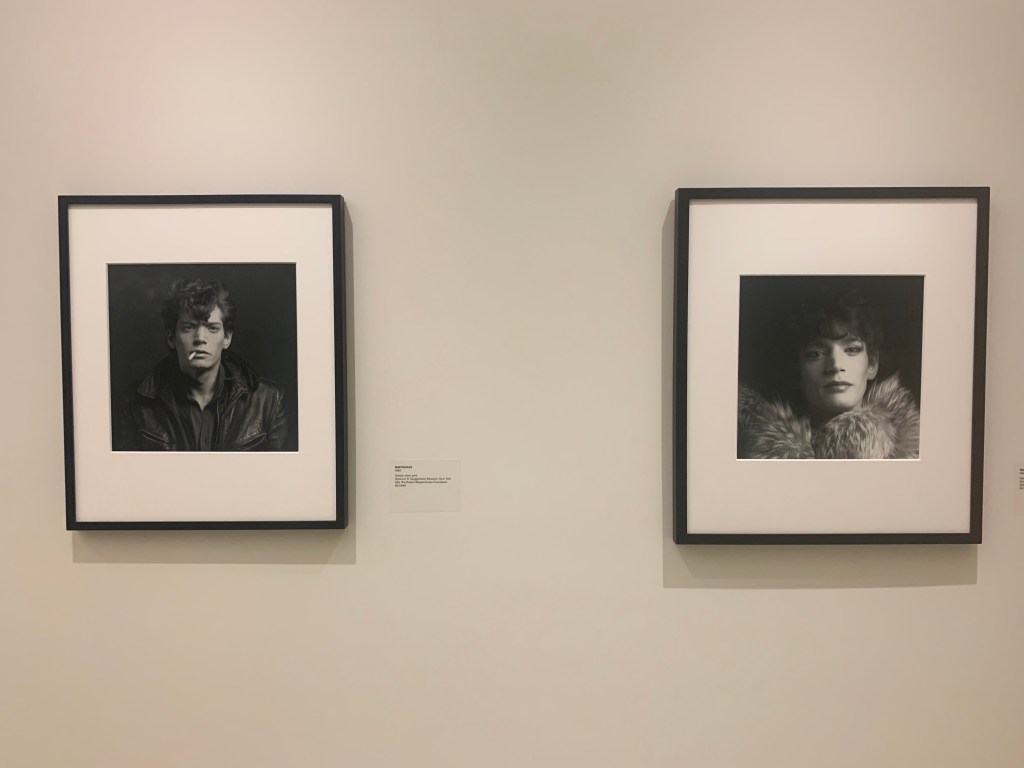
Mapplethorpe keeps a rather straight face in both pictures. It’s unclear what he’s thinking, but we know what we’re thinking when we see it. One screams MAN and the other is ambiguous. A lit cigarette dangles out of his mouth in the masculine self portrait. His furrowed brow, tousled hair, and upturned leather collar communicate masculinity in its toughest form. Yet he looks a little puzzled. It’s almost like he’s unsure of his appearance, left wondering if this is how people really see him. His usual confidence is replaced by uncertainty.
In the more feminine self portrait, Mapplethorpe cracks a subtle smile or laid back smirk even. This outward display of femininity is more authentic for him he seems to tell us. I’m reminded by the knowing yet somber half smile and sparkling eyes of Leonardo’s beloved Mona Lisa. Mapplethorpe looks more sure of himself in this portrait than he does in his leather jacket. He even snapped a similar self portrait in make-up with his bare chest exposed.

His dramatic eye shadow, glossy slightly parted lips, and long untamed hair is sensual, but Mapplethorpe stands naked and vulnerable. The photo’s erotic undertones are paralleled with Mapplethorpe’s bony build. His collarbone and sternum sit pronounced under his skin and Mapplethorpe appears to look just slightly left of the viewer’s gaze like he can’t match your gaze anymore. You’re looking at him as a voyeur, but he looks past you. He is object and subject at the same time.
This is a softer side of Mapplethorpe that rivals his butt plug BDSM persona. Some called him hedonistic, but he really just wanted us to ask questions and get us to pause and appreciate beauty. Flowers, bodies coming together, lovers, people, all of it. Mapplethorpe’s photographs don’t only pose questions surrounding sexuality and pornography, they also communicate the unspoken anxieties of a gay man living and loving during the 1980’s AIDS pandemic. They are steadfast and provocative but they are equally insecure about unpredictable and dangerous times, much like the ones we are living in now.
 A Place for Words