
Alice Neel (1900-1984) was once dubbed a “collector of souls” and I think that’s an astute title for the portrait artist. Her paintings–which have been described as embodying an Expressionist Realism–capture, above all, the vulnerability of their subjects.
This portrait of Andy Warhol was created only 2 years after he was shot by radical feminist, playwright, actress, and author of the SCUM Manifesto: Valerie Solanas. Warhol was declared clinically dead for two minutes after one of Solanas’ three shots punctured his lung. Warhol would die from complications related to the gunshot wound decades later.

I could go on to write about the motivations behind and implications of Solana’s intent to murder Warhol, but that’s not my intention. I’m writing to explore Neel’s depiction of Warhol and how it speaks to the larger meaning and purpose behind her works.
In “collecting the souls” of her sitters, Neel positions them at their most unguarded. Many of her other portraits portray nakedness. (I’d like to note the distinction between being naked and being nude as laid out by art critic John Berger. Neel doesn’t necessarily place her sitters on display in an exploitative or voyeuristic manner–which would constitute nudity in this case. Rather, their nakedness provokes the viewer to foster a greater empathy for the sitter’s humanity. They’re not to be looked at as an object, but to be engaged with as someone with complex interiority. There is no disguise.)
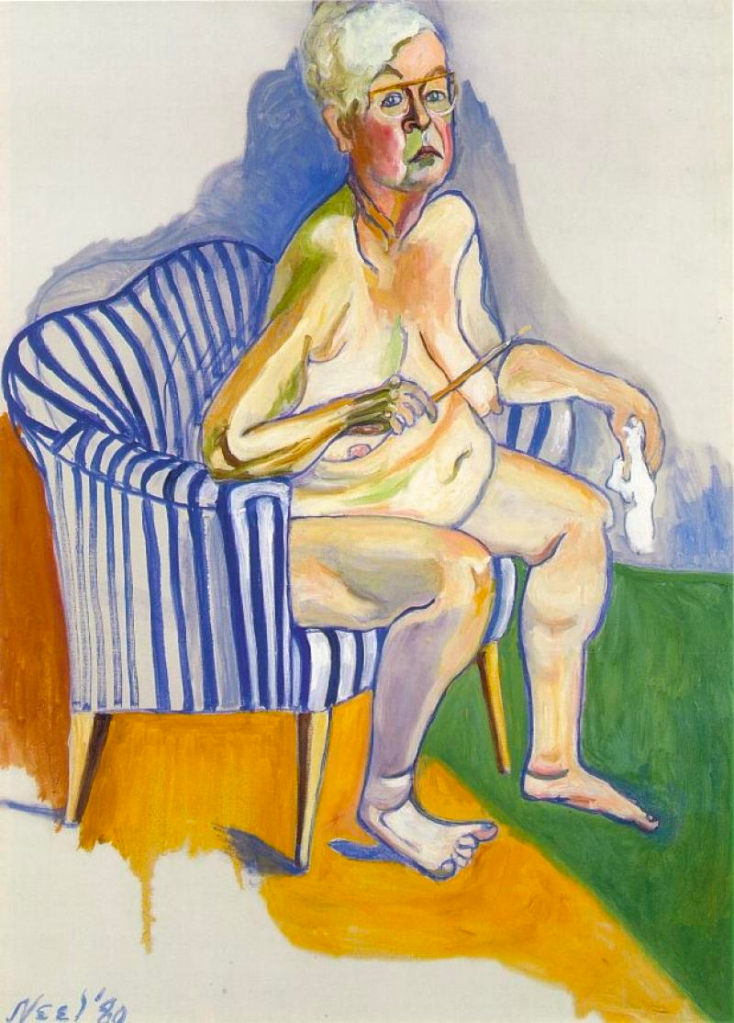
Andy Warhol is a somewhat enigmatic figure in history. His eccentric personality made him magnetic. There was and has always been intrigue surrounding the artist. Years ago, I read The Philosophy of Andy Warhol: From A to B and Back Again, which gives you insight into the mind of the artist. This autobiography teeters between stream of consciousness and a meticulously crafted meditation on life. It covers money, love, consumerism, and more.
Naturally, because of his enigmatic image, he was and is still, I think, elevated to a sort of abstract level–as are many famed figures throughout history. Neel’s painting brings Warhol down from the intangible to the human. After all, he is one of us, even if his enduring reputation makes him seem not so. Warhol’s facial expression comes off calm yet tired. The blue contour and hues lend themself to this sense of stillness. This blue contour is present in a lot of other Neel portraits. I believe this blue outline contains the scene and sitter. Time seems to slow and stop altogether.
Knowing the context of the Warhol portrait deepens the visual melancholy. His stitched and sagging chest looks pitiful. It is deeply vulnerable and feels as though his wounds will split open and expose his insides. In this painting, he ceases to be Warhol the iconic painter and returns to his true identity as Andy the man.
I especially love how the painting appears unfinished. Neel deliberately chose not to fill in the couch Andy sits on, instead representing it with thin, imperfect lines. She even leaves his left knee as a sketch. Could it be a reference to the weakness inflicted by the attack? A sort of loss? Unraveling? Is it an erasure of the facade that abstracts Andy the man and results in our perception of Warhol the iconic painter?

Neel lived a very difficult life, which included the death of one child and suicide of another, poverty, and an estranged husband. Any of these circumstances would leave a person traumatized for life. Despite these misfortunes–or maybe better put–because of these misfortunes, Neel perceived people on a deeper level. Her portraits peel back the society-facing surface that people often hide behind so to cloak their anxieties and insecurities.
What would we look like if we embraced these inhibitions instead of burying them? I imagine we would look a lot like Andy in Neel’s portrait. Beautiful in our vulnerability and deserving of empathy. Resigned to the hardships of life. Resilient not in a heroic way, but in a human way. Going on not because we want to, but because we have to. Life keeps moving, even if Neel’s portraits hush that movement.
Check out more of Neel’s works here.
 A Place for Words