Surrealist animator Wong Ping knows a thing or two about absurdity. Actually, I think he encapsulates what it means to be absurd. He finds and shares the meaning in it. He manages to make it humorous and at times even facetious. He encourages us to laugh–and even feel a level of discomfort at the sometimes unsettling animation and subject matter, often dealing with sex, family, and relationships. But he also coaxes us to look inward at our own desires and anxieties.
Born in Hong Kong in 1984 and pursuing a bachelor’s degree in Perth, Ping tried his hand at journalism before starting the Wong Ping Animation Lab in 2014. His Instagram bio, in all of its contradictions, embodies his satirical ethos. After all, he considers himself a comedian:
A devout atheist. An optimistic pessimist. A slow living fast food waiter. A weekend vegetarian. Your silence neighbor.
Wong Ping on Instagram
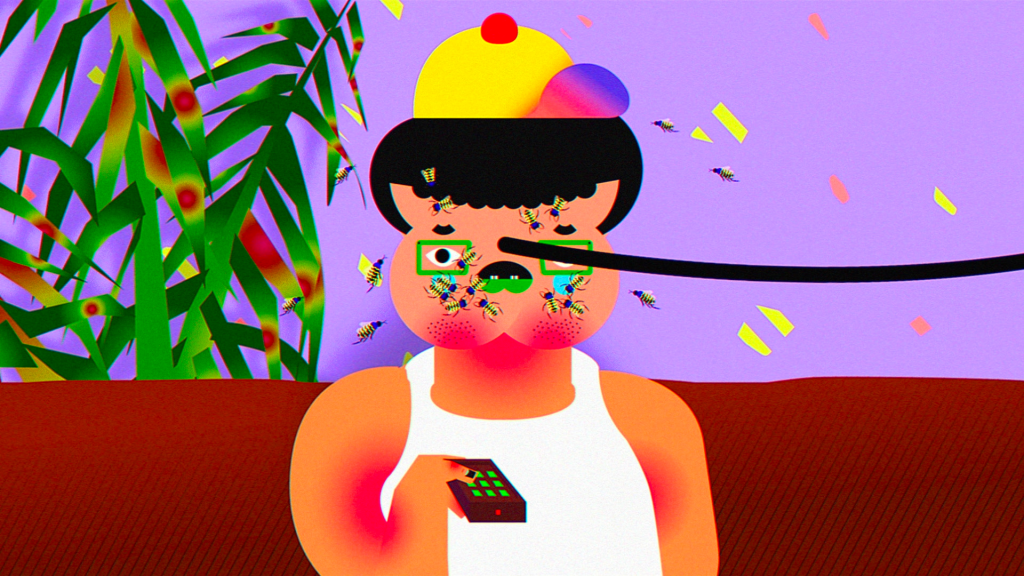
Every time I see his videos and installations in museums, I know I’m in for a treat. He’s one of the few artists who can absorb me into his videos for their entirety. They’re rarely longer than 10 minutes and even then, they go by quickly given the fascinating visuals and unique storytelling.
An Emo Nose is a piece I remember well, having watched it at the Wong Ping’s first American survey exhibition at the New Museum in 2021. A screen was set on the gallery floor, propped against the wall so that you had to look down at it. I’ve seen people sit on the cold slab of the floor to watch.
A recurring motif in An Emo Nose is a cluster of bees. I think this is Wong Ping nudging the idea of hive mind. That we rarely think truly for ourselves, but rather go along with the decisions of the majority. Like worker bees who have few purposes in life outside of feeding the queen, collecting pollen, and creating beeswax, we humans share a lot of the same goals, whether we like it or not. We seek out friendships, sex, and work. We struggle to fit in, but often try desperately to do so even though standing out is sometimes applauded. (If you do it right.)
The human protagonist of An Emo Nose admits rather cynically to going through the motions of spending time with friends, if only to appease the teachers who recommended this to him. In aligning with that hive mentality, the protagonist goes along with what is generally accepted. His closest “friend” (very close, being that it is connected to his face) is his nose, shaped like an upside down heart which grows longer when exposed to negative energy. It makes you think about the things we do to keep those we care about close to us. And even those we don’t care about, but are fearful to lose and become alone. We fear distance even if we crave alone time.
The video ends on an optimistic note, depending on how you interpret it. The nose stretches so far, lives out its own independent life, and wraps all the way around the globe to return to the protagonist. Is their reunion for the best? Will the protagonist be able to quell his qualms with his nose? Or will his annoyances only bubble up again and lead to this cycle of separation and unity?
Something common to just about every Wong Ping video I’ve seen is that it is narrated by an omniscient third person–always off screen, always straightforward and blunt in their words. Or we are granted access into the main character’s internal monologue, as is the case in An Emo Nose.

I’ve always loved absurdity and paired with these neon, highlighter bright colors that Ping loves to use, his bizarre stories are captivating. Keep your eyes–or nose–out for the gloriously weird things Ping will make next.
 A Place for Words