Robert Mapplethorpe’s “Self Portrait” (1980)

black and white self portrait of Robert mapplethorpe in leather jacket with lit cigarette looking at viewer from chest up
Self Portrait via whitney.org

Robert Mapplethorpe was a free soul who could achieve the blackest black in his photographs you can’t believe your eyes when you look at them. He has been called one of the most fearless image-makers of the 20th century. His photos are intimate and vulnerable with the sitter often engaging directly with the viewer. They’re lovers, artists, gay men, body builders. He captured flowers, faces, phalluses, and bodies pushed to the limit.

Believe it or not, he grew up Catholic. He assembled sculptures and paints wooden frames. He loved magazines and collage art. He did it all and he mastered it all. He would stare at the glamor magazines in store windows in Manhattan where he lived and worked, bumming around with Patti Smith in Greenwich Village. He had a passionate love affair and lived with the punk rock legend, writer, and poet during the late 60s and into the 70s.
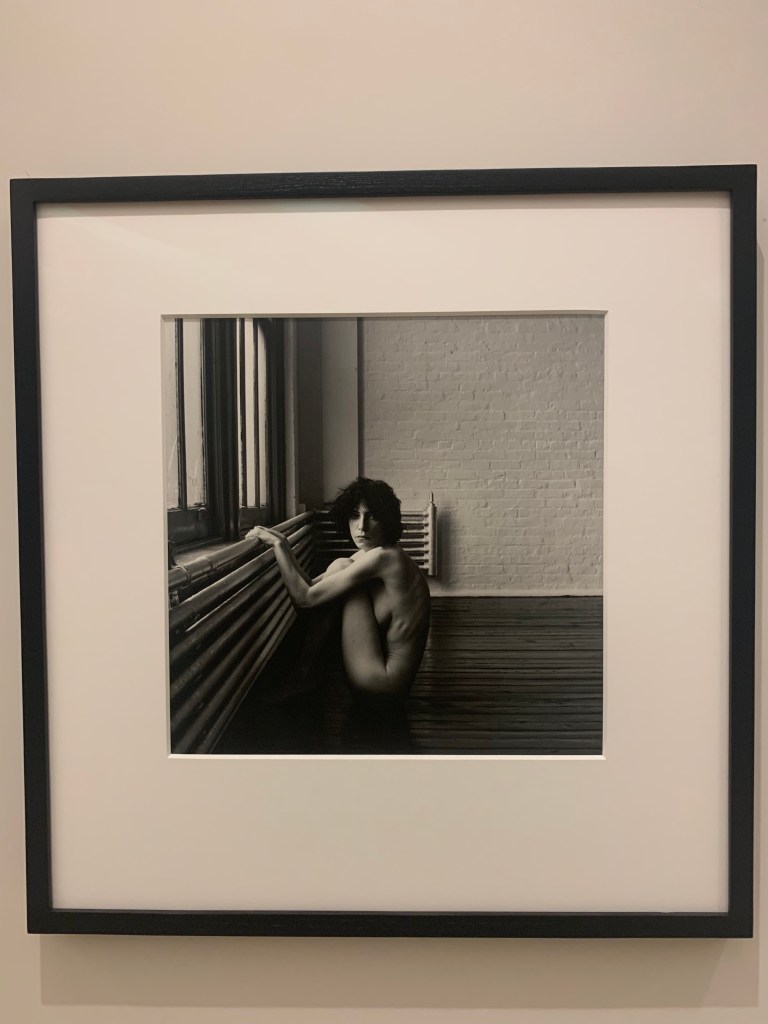
black and white photo of patti smith nude and crouched down on her toes holding a furnace in a bare white brick apartment
photo by yours truly, portrait of Patti Smith @ the Guggenheim

Sadly, Mapplethorpe died due to HIV/AIDS complications in 1989 at the ripe age of 42. He was sexually fluid and involved with numerous men including the famed curator Sam Wagstaff and professor and editor Jack Fritscher. Mapplethorpe was bold and “out there”, but he never really wanted to be shocking. He was no stranger to censorship and protest given the confrontational nature of his work. One famous photo shows the artist from behind bent over at the waist with a butt plug and a trailing whip inserted in his ass. He stares unapologetically, almost intimidatingly out at the viewer as if to ask what are you looking at? There were retrospectives where photos from his so-called X portfolio were contested. At one exhibition, Mapplethorpe was served papers by a dozen policemen who found him guilty of displaying obscenities.

Their frustration simply generates more buzz around the artist and circulates the image to more people. We’re naturally curious about the profane. The taboo.

Academics and respected thinkers criticized Mapplethorpe’s depictions of Black men. Some claimed he was exploiting Black men by reducing them only to their genitals and sexuality, reinforcing stereotypes about the significant size of Black men’s genitals, and making these images inherently racist. On the other hand, some say that Mapplethorpe celebrates the Black male form, a body long denigrated in art history. They say that the men’s eye contact with the viewer gives them agency and power. Mapplethorpe himself had intimate personal relationships with some of the models like Ken Moody. His photographs of Moody challenge perceptions of what Black masculinity can be. He photographed Moody nude with flowers and alongside other nude male models.

black and white photo with soft vignette circle of shirtless ken moody with flower held above head
Ken Moody by Robert Mapplethorpe via artnet

The curators smartly juxtaposed hand-selected quotes criticizing or praising Mapplethorpe’s work and its relationship with Black men. In three horizontal registers, museum-goers could read framed quotes sandwiched between Mapplethorpe’s photos. It was beautiful and thought-provoking to see. Profound thinkers and writers including bell hooks, Audre Lorde, and model Ken Moody himself weighed in on the photography.
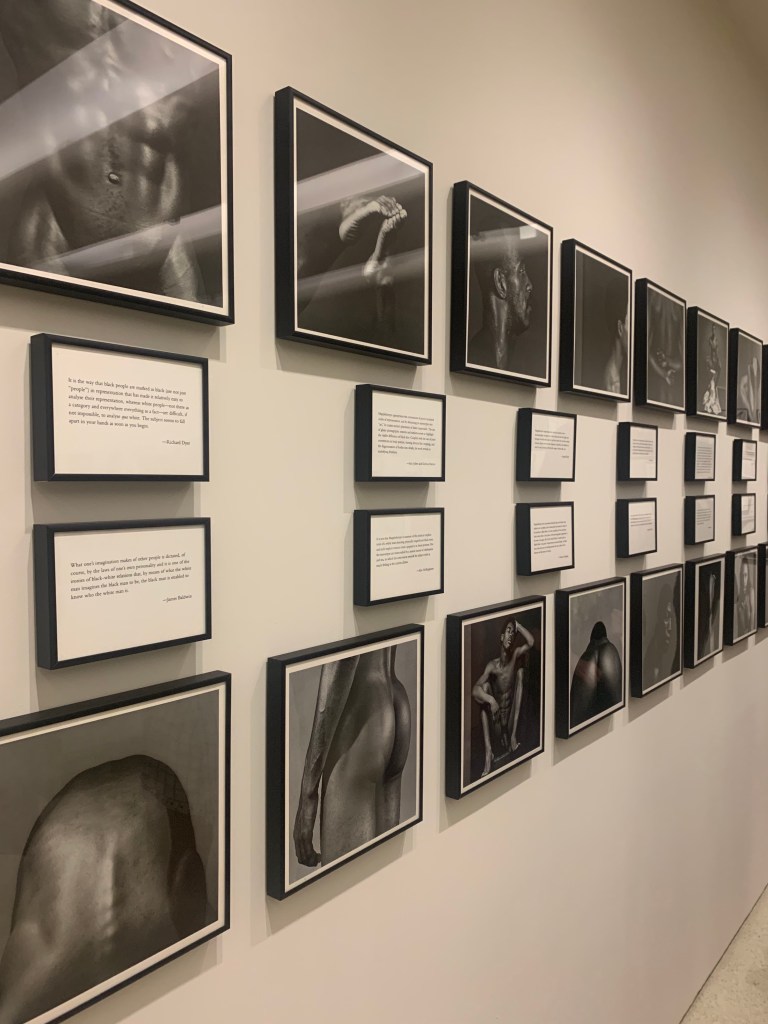
picture from guggenheim exhibition of framed quotes and pictures
photo by the author in the Guggenheim museum NYC

Despite the criticism, Mapplethorpe was confident in himself and his artistic self-expression. He often photographed himself in drag with make-up and costume. When I visited the two-part Implicit Tensions: Mapplethorpe Now at the Guggenheim Museum, I was excited to see the below two self portraits exhibited next to each other. They communicate with each other as much as they do with the viewer. They were situated at the start of the exhibition as if they were greeting visitors on their way in. The juxtaposition speaks volumes to Mapplethorpe’s gender performance too.
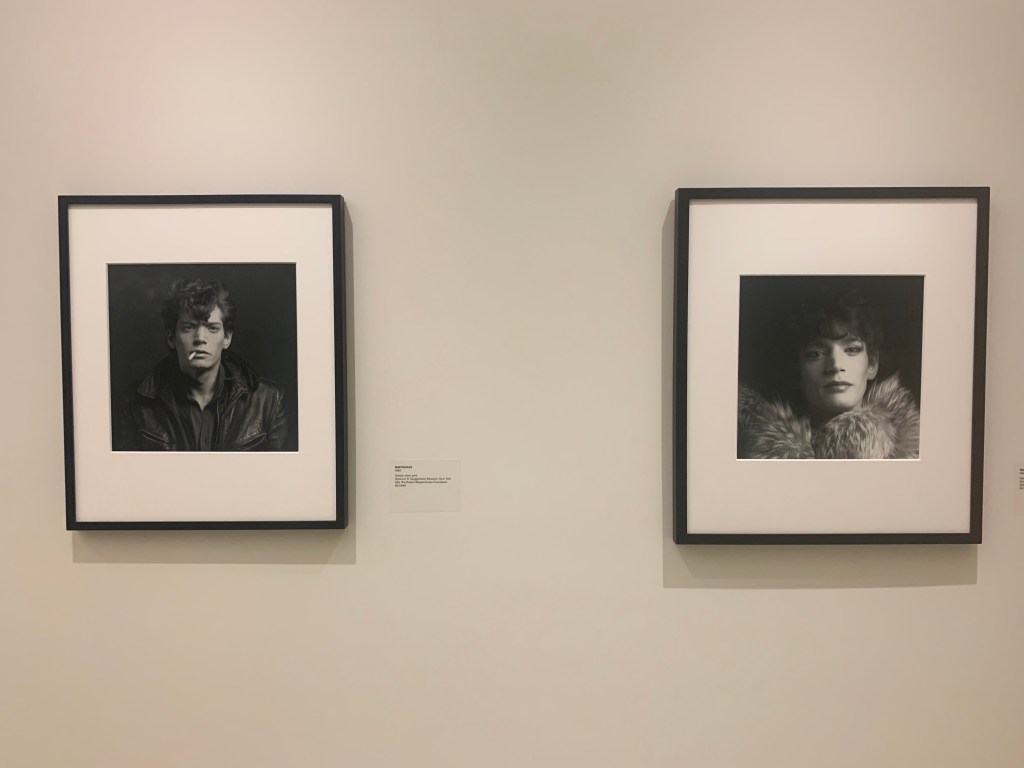
picture of Guggenheim exhibition depicting two separate framed portraits of the artist
photo by the author at the Guggenheim Museum NYC

Mapplethorpe keeps a rather straight face in both pictures. It’s unclear what he’s thinking, but we know what we’re thinking when we see it. One screams MAN and the other is ambiguous. A lit cigarette dangles out of his mouth in the masculine self portrait. His furrowed brow, tousled hair, and upturned leather collar communicate masculinity in its toughest form. Yet he looks a little puzzled. It’s almost like he’s unsure of his appearance, left wondering if this is how people really see him. His usual confidence is replaced by uncertainty.

In the more feminine self portrait, Mapplethorpe cracks a subtle smile or laid back smirk even. This outward display of femininity is more authentic for him he seems to tell us. I’m reminded by the knowing yet somber half smile and sparkling eyes of Leonardo’s beloved Mona Lisa. Mapplethorpe looks more sure of himself in this portrait than he does in his leather jacket. He even snapped a similar self portrait in make-up with his bare chest exposed.

Self Portrait (1980) via guggenheim.org

His dramatic eye shadow, glossy slightly parted lips, and long untamed hair is sensual, but Mapplethorpe stands naked and vulnerable. The photo’s erotic undertones are paralleled with Mapplethorpe’s bony build. His collarbone and sternum sit pronounced under his skin and Mapplethorpe appears to look just slightly left of the viewer’s gaze like he can’t match your gaze anymore. You’re looking at him as a voyeur, but he looks past you. He is object and subject at the same time.

This is a softer side of Mapplethorpe that rivals his butt plug BDSM persona. Some called him hedonistic, but he really just wanted us to ask questions and get us to pause and appreciate beauty. Flowers, bodies coming together, lovers, people, all of it. Mapplethorpe’s photographs don’t only pose questions surrounding sexuality and pornography, they also communicate the unspoken anxieties of a gay man living and loving during the 1980’s AIDS pandemic. They are steadfast and provocative but they are equally insecure about unpredictable and dangerous times, much like the ones we are living in now.
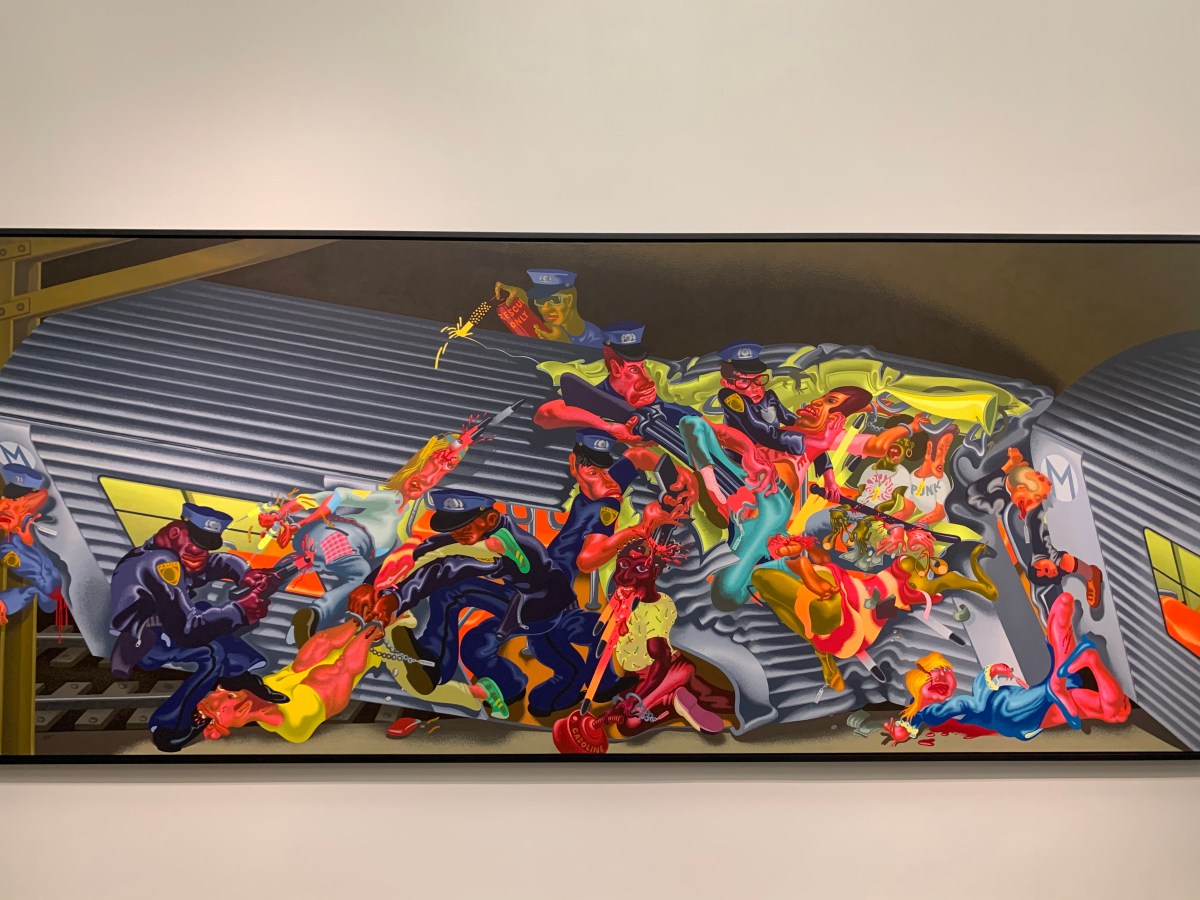
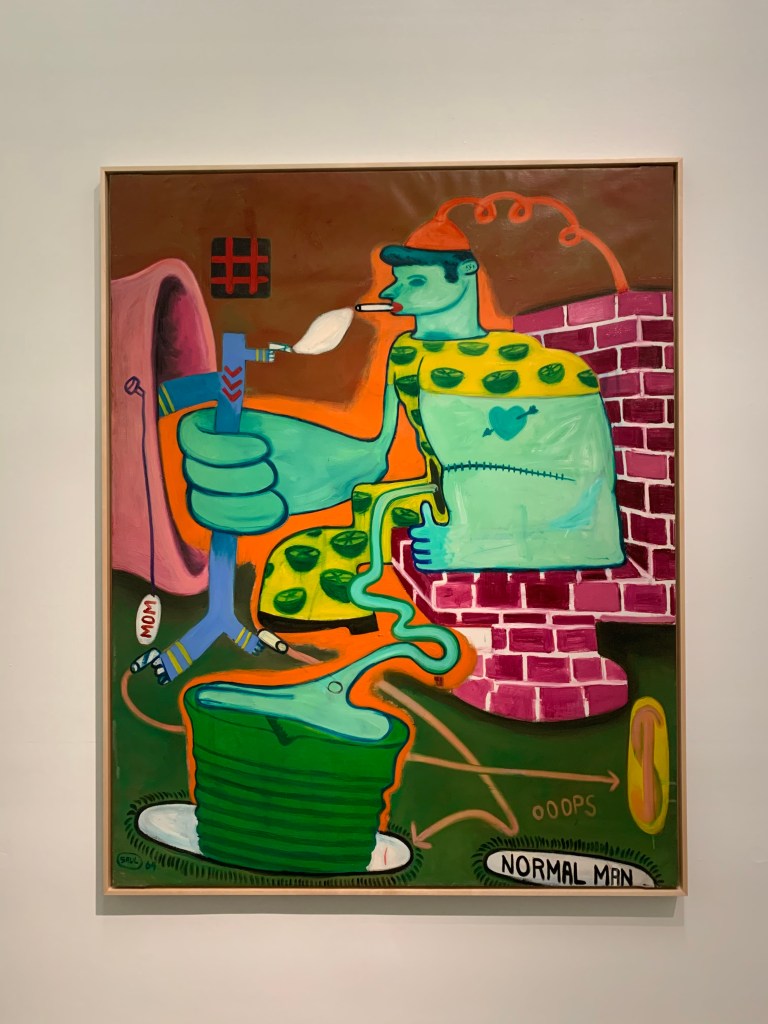
Peter Saul’s “Subway I” (1979)

photo by yours truly @ the New Museum, NYC

Peter Saul is an American painter whose vivid, eccentric paintings elicit an almost visceral response. Whether it be startled, disturbed, or intrigued. Many of his pieces function as a political commentary with some linked to the Vietnam War, Ronald Reagan, the war on drugs, corruption, among so much more. He straddles movements, fluctuating between the absurdity of surrealism, the flamboyance of pop art, and the energy of expressionism. His figures look like caricatures, over exaggerated and cartoonish. Some canvases are borderline grotesque and you’re compelled to look away but you’re simultaneously drawn to the work. They’re powerful like that.

Saul’s art exposes the ugly and uncivil in a way that’s affective and reproachful. His paintings are littered with genitals, blood, and violence. “I guess [I’m] a leftist… I have trouble with authority,” Saul said in an interview later in his life. He even describes his perspectives on the issues he addresses as a bit facetious, but I personally find his sardonic style persuasive. It’s captivating. It makes you think. It pushes you to consider unpleasant histories and the longstanding–often unjust–systems we have in place.

photo by yours truly @ the New Museum, NYC

I hadn’t learned much about Peter Saul until I saw his Crime and Punishment exhibition at the New Museum. The show was fantastic. Vibrant, busy paintings suspended in salon style on the museum’s white towering walls. The floor was crowded with people, their heads angled in every direction. There was murmuring, pointing, snickering, bickering. All of it. These are big paintings, too. Big paintings for big ideas. Saul wasn’t afraid to call out what he saw as hypocrisy, bigotry, or hatred.

In Subway I (the first photo), Saul depicts a crushed, warped subway car packed with exaggerated characters who spill out of the M train’s broken windows. Their bodies are entangled with each other. Police handcuff, stab, shoot, and strangle civilians of all colors. It’s pure mayhem and almost uncomfortable to look at.

I’m thinking about this painting especially today after the unjust murder of George Floyd. He is far from the first and far from the last Black man to die a senseless death at the hands of police brutality. For centuries, Americans have treated Black bodies like they’re disposable. And Saul’s Subway I touches on that, but it doesn’t centralize the Black experience, it makes it part of a larger whole.

I scoffed at the irony of the officer near the top of the canvas who dribbles an unknown substance from what looks like a fire extinguisher. It’s marked Rescue Only. ‘To serve and protect’. Isn’t that what the police are supposed to do? Who are they serving? Who are they protecting?

The whole thing doesn’t sit right with me and clearly it didn’t sit right with Peter Saul either.

Nam June Paik’s “Electronic Superhighway: Continental U.S., Alaska, Hawaii” (1995)

via Smithsonian American Art Museum

Korean-American artist Nam June Paik coined the term “electronic superhighway” to refer to how media connects and transforms our lives. Considered to be the first video artist, he’s no stranger to the power of moving pictures. He knew that television and film could shape people’s perceptions of reality and consequently, reality itself. And just think of how the media landscape has changed since Paik created this work 25 years ago. Today, we have iPhones, social media, Netflix, Google, Amazon. You can talk to someone across the globe one minute, shop online the next, and have your package arrive on your doorstep a day later.

Social media has us more connected than ever even though some may argue it isolates us from those around us because of its addictive qualities. You’re telling me a gambling strategist designed this software?

Electronic Superhighway: Continental U.S. is composed of 336 one-channel televisions, 50 DVD players, nearly 600 feet of neon tube lights, and a shit ton of cables. Seriously, what does the back of this thing look like? As you stand in front of the installation as I was lucky enough to do in the Smithsonian Museum in Washington D.C. a few years back, you are bathed in neon light. A cacophony of monitors flash and blink at you. Look one way and clips from the Kentucky Derby play on loop, footage from the civil rights movement in Mississippi, and politicians caucusing in Iowa. Shift your gaze to watch choreographer Merce Cunningham, icy panoramas in Alaska, and scenes of potato farms in Idaho. A rainbow of light like stained glass decorates the normally crisp white gallery walls. It’s really spectacular to experience.

It’s a TV map illustrating how Paik understands each state and his perceptions aren’t uncommon. Like national identity, a state’s identity is communicated through its televised image. Of course these are over-generalizations but they reflect how we condense people, food, politics, and entertainment into our image of a place.

Paik moved to New York in 1964, flooded with its consumer culture and advertisements. We are perhaps connected now more than ever but it’s overwhelming being inundated with this much information all the time. Media moguls control what we see and how we see it. They shape how we understand regions and people and this work demonstrates that phenomenon perfectly.

Think about a news story that involve a place. Florida man attacks nephew over undercooked noodles. California teens flock to beaches despite lockdowns. Unarmed black man murdered by white supremacists in Georgia while out for a jog. How does that affect your understanding of these states and their people? How can these stories embolden prejudice and stereotypes?