Origin by Tschabalala Self via tschabalalaself.com
Tschabalala Self is a Harlem-born mixed media painter. She uses intricately patterned fabrics and broad loose brushstrokes to depict Black bodies. In her words:
The work is political because it’s politicized; politicized bodies are featured in the work. I’m a political person because if I wasn’t a political person, that would affect my safety and well-being in the country. But that’s not why I’m making the work. I’m making the work to leave a document of the experience of people who are like me.
via tschabalalaself.com
Self is particularly interested in highlighting women’s bodies and the experiences of black women. At her exhibition at MoMA PS1, I felt as if I was being enveloped by her life-size canvases. The figures challenge you in a way. They take up nearly the whole canvas. They often stare back at you, refusing to be looked at without looking back.
They’re almost intimidating, but not in a violent way, more-so in an awe-inspiring way. The way a deity is intimidating. But they’re vulnerable at the same time. The woman in Origin is reminiscent of a fertility goddess. A spiritual being personifying creation, life, birth, and abundance. Her pose resembles a circle which symbolize the continuous cycle of birth and death. And the centralization of her vagina reminds us of our origins.
via tschabalalaself.com
Self presents Black women and queer bodies as fluid forms and identities. They cannot be reduced to a single story or pinned down to a single incomplete trait. They take up the space even though it’s been historically discouraged and is still to this day discouraged. Black woman who take up space are time and time again considered aggressive. So what is the alternative? To be passive? Self’s women assert themselves.
The patterns and textures recall quilts like the ones Black women (think Harriet Powers, Faith Ringgold, Bisa Butler) have handcrafted to convey stories. Through Self’s works, we can see patterns–in the way these paintings carry on the narratives and ideas put forward by many other Black female artists.
elevator pitch installation shot via christinesunkim.com
Somehow, over time, the elevator became synonymous with awkwardness. From social experiments where people get in elevators and face towards the back to jokes about people panic pressing the “close door” button when someone’s approaching, we seem collectively fascinated with the elevator experience. Just think: how do you feel when you step into an elevator with a stranger or group of strangers? Are you nervous some punk on YouTube is going to prank you into thinking the antichrist has joined your ride? How does the number of people and noise level inside influence your experience?
All this talk of elevators and it still took me 21 years to realize that deaf and hard-of-hearing people experience elevators in completely different ways than others do. In fact, they experience much of life differently and ableist thinking and infrastructure hinder their day to day lives. Elevators are just never microcosms that I considered for their sensory qualities. Yet nearly every one of our senses is engaged when we step foot in these metal people movers. We smell the stale carpet and faint waft of cleaning agents mixed with a woman’s fancy perfume. We hear what’s coming through the speaker, music so distinct in its stereotypical sound that we dubbed it “elevator music.” We see the buttons light up as we press their chilly metal surfaces and watch (un)patiently as the floor numbers change above the doors. Hopefully you’re not tasting anything in an elevator so we’ll leave that sense out.
Maybe the silence in an elevator is just awkward because we don’t like to be in hushed, enclosed containers with people we don’t know with nothing to really look at or watch.
elevator pitch installation shot via christinesunkim.com
Elevators are the subject taken on by American multimedia artist Christine Sun Kim for her interactive 2019 installation, elevator pitch, at the Music Box Village in New Orleans. Elevator pitch is part of an ongoing series of “musical houses” at the Village where visitors can have immersive experiences in spaces designed by artists.
Kim grew up deaf in southern California with hearing parents and a deaf sister. She’s currently based out of Berlin, and recently signed the national anthem at the 2019 Super Bowl. Not to mention, she’s like really fashionable and all-aroundcool. She has a boatload of art degrees from different institutions and specializes in sound art which may seem ironic for a person who can’t hear, but Kim’s works explore the dimensions of deaf culture and the discrimination deaf people face today.
from the 2019 Whitney Biennial via whitney.org
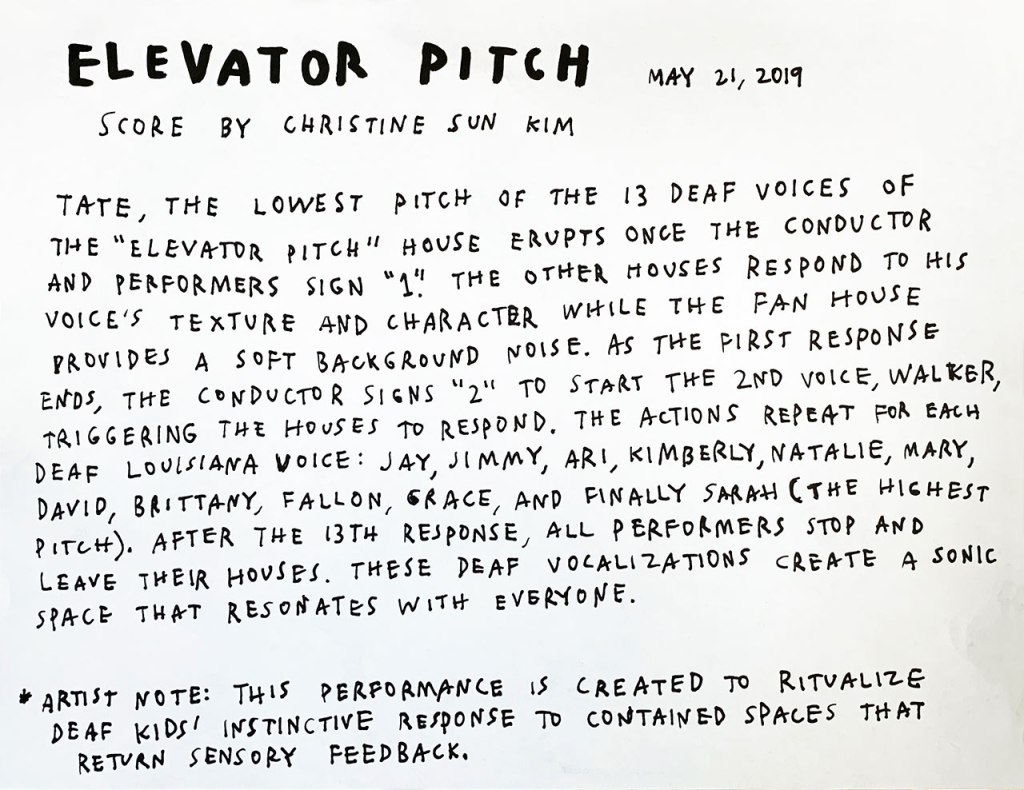
Created in collaboration with other artists, curators, and the New Orleans Airlift, elevator pitch was inspired by Kim’s childhood experiences in elevators with deaf friends. She recalls them shouting in unison at the top of her lungs to see the vibrations of their sounds. It’s sound as a sensation and feeling. Elevator pitch makes you consider how people of different abilities experience the world.
elevator pitch description via christinesunkim.com
It’s a playful way to make you think about the harder stuff. The work’s title alludes to the hyper-capitalist notion of selling yourself as a job candidate in the elevator with just the time it takes to arrive at your floor–typically in under 30 seconds. A pitch is also the tone of a note, how high or low it is. One can be off pitch. A pitch can be high and joyous or it can be low and foreboding. A pitch always elicits a response from the listener. It can make you turn the volume on the radio up or grimace and cover your ears. It can even shatter glass.
In elevator pitch, one’s pitch determines the vibrations in the container and impact the sensory feedback. Your voice has the power to alter your environment in ways you can’t necessarily see but can feel.
elevator pitch image via christinesunkim.com
It’s no coincidence that this installation lived in New Orleans as music is so integral to the southern city’s past and present. The birthplace of jazz. Musicians flocked to the New Orleans in the early 20th century, their trumpets, trombones, and basses in tow. Jazz dances out of bars and homes in the French quarter and on Bourbon Street. It was jubilant and contemplative and exciting and it was also sorrowful and melancholic. Music began to construct the identity of a place, its people, and its cultures. And music carries the memories of generations in its lyrics and style.
We don’t think often enough about sound. As I sit here tap tap tapping on my keyboard and listening to the stream of a neighbor’s nearby fountain, I suddenly have a heightened awareness of what I can hear and how it contributes to the atmosphere. These sounds are happening outside of me and most of them I can’t control. To some people, these sounds are a nuisance and to others they’re soothing. Some rely on ASMR to relax and calm anxiety, others find it creepy and unnerving. Sound is subjective. Much like the elevator experience. Much like all experiences really. I think it’s important we remind ourselves of that often.
Sunday, I wake up to the sleepy sultry strum
of an unlearned untuned guitar
and I'll smile at that lovely languid lilt you do
once you hit that sweet spot,
a silvery sound knotted in cedar wood.

You learn to match its pitch in time
to mirror your raspy reticent hum
as your fingers pluck at dusty bronze
and you muse about pretty things.

The water droplets cling like smoke to hair
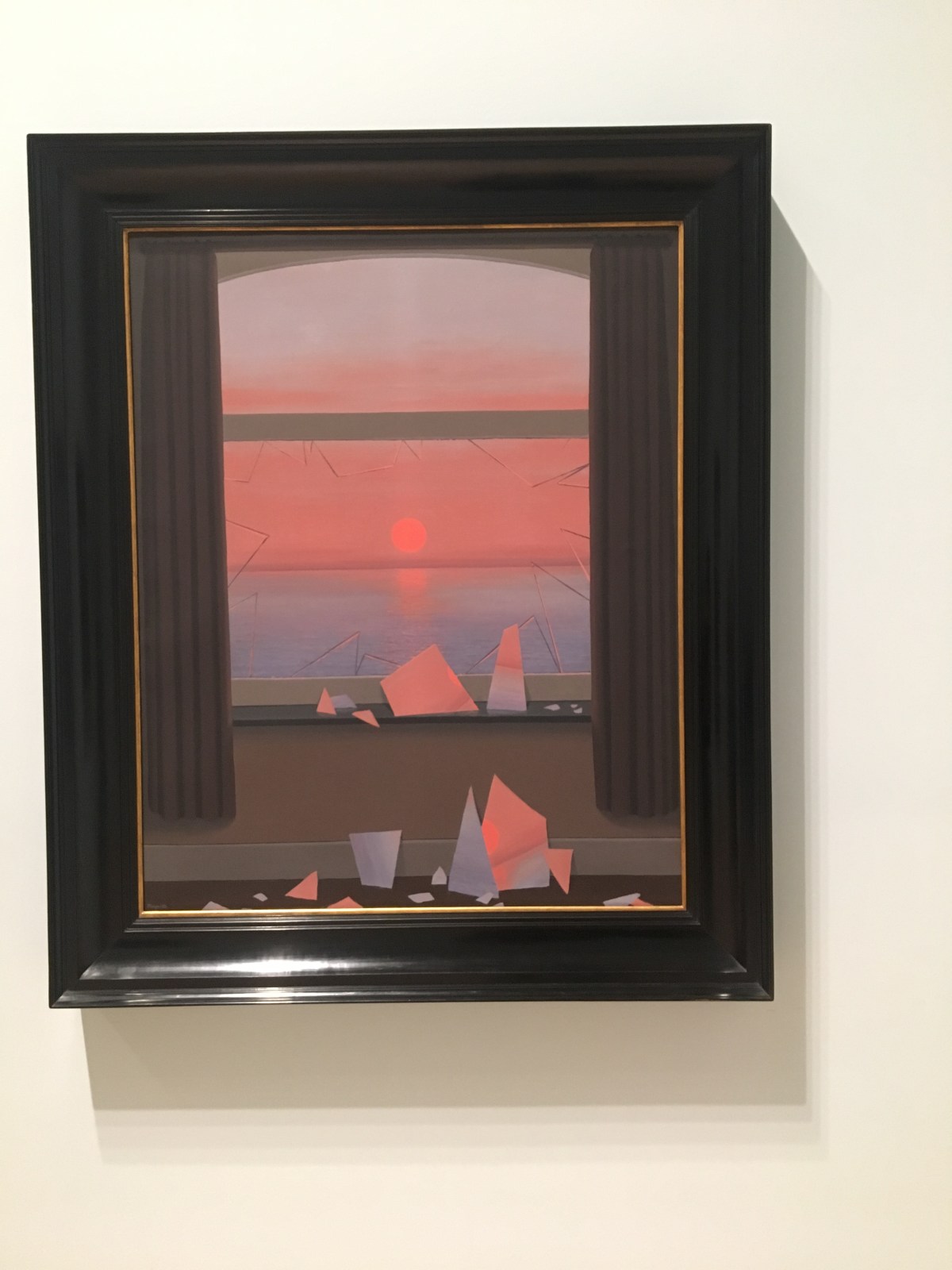
onto the speckled glass of a cracked ivied pane
so we can breathe in April’s prodigious petrichor
while you go on singing your siren song.

This is your morning melody on a Martin
like Bobby D on Macdougal Street,
back in the Hootenanny days
when your music was your legacy
and your lyrics flowed like poems do.



 A Place for Words