All I want to know now
after years since our final exhale--
now that the debris of all we wrecked
has settled into nothing more than a forlorn dune
sterile and desolate, barren and dry from neglect,
a mirage of what was never really there.

Do you still think of me at all?
I think of you when I cross the desert--
a refraction of light
the prick of a cactus
I hate that I think of you at all,
it was you who knowingly sparked the serpentine fuse
that would ignite a raging wildfire between us.

As you evaporate in my consciousness,
I can't help but wonder again and again
have I become just a speck to you?
an inconvenient smudge of dirt
on the surface of your searing mind
blazing with girls' splintered hope,
hearts burnt well before mine.
I don’t think I’ve ever seen an artist show texture in a two-dimensional painting quite like Toyin Ojih Odutola does. The Nigerian-American painter makes skin looks alive, a dynamic and beautiful blend of light and shadow pooled together. She combines pastels, charcoal, and graphite on paper and canvas to create something mesmerizing.
Hers are the type of paintings that look different depending on how the light hits them. In a recent CNN spotlight, Odutola told the reporter:
When I look at black skin, I think of it as a mercurial surface — a terrain, a construct, a projection, but also a place where so much beauty and positivity proliferates. It includes so much and it holds so much.
Between the Margins (2017) via jackshainman.com
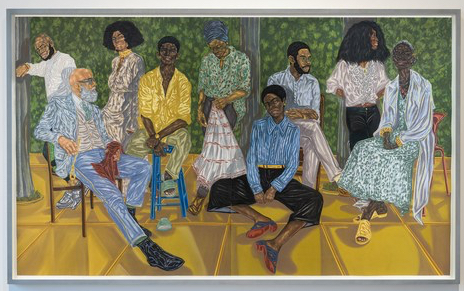
Odutola’s subjects pose calmly and confidently. They are unapologetically and proudly Black. In The Firm, a group of adults stretch out across the composition. Some sit nonchalantly while others lean against pillars. Some look away and others look directly out at you. The work is huge. Life-size. Gold accents on jewelry, the flooring, and belts give the painting an air of royalty. As if they all belong to a distinguished bloodline. It’s Blackness as power.
In fact, Odutola’s work was included in an episode of Pose, the FX show that explores the social scene of late 1980s New York City from the vibrant drag community in Harlem to extravagant balls and night life. In the first episode of the first season, a team of characters steal from the Brooklyn Museum. During the scene, the characters are affected by iconic artworks, mostly from the Egyptian wing, inextricably linked to Blackness. They eventually strip an entire exhibition of its contents, escaping the museum with spectacular costuming and modeling the gowns in a lively pageant for one another. It reminded me of the beginning of Black Panther, when Michael B. Jordan’s character stands in front of a glass vitrine in the British Museum and debates museums’ ownership of Black artifacts with a suspicious museum director.
One cannot claim ownership over something that was never theirs to keep.
POSE S1E1 Brooklyn Museum scene
Odutola crowns, empowers, and centralizes Black people and their experiences. She cites comic books, cartoons, and mythology as inspirations. The textural nature of her art and the deity-like appearance of her figures give them a certain weight and stability that leaves you awestruck. You are in the presence of something splendid.
Kerry James Marshall was born in Birmingham, grew up in Los Angeles, and now lives in Chicago. If anyone is intimately familiar with tense and violent race relations, it’s KJM. His family home in LA was near the Black Panthers’ headquarters, instilling a political and social consciousness in him from a young age. You can see it clear as day–or better yet, clear as night–in his art.
“Untitled (Policeman)” (2015) via moma.org
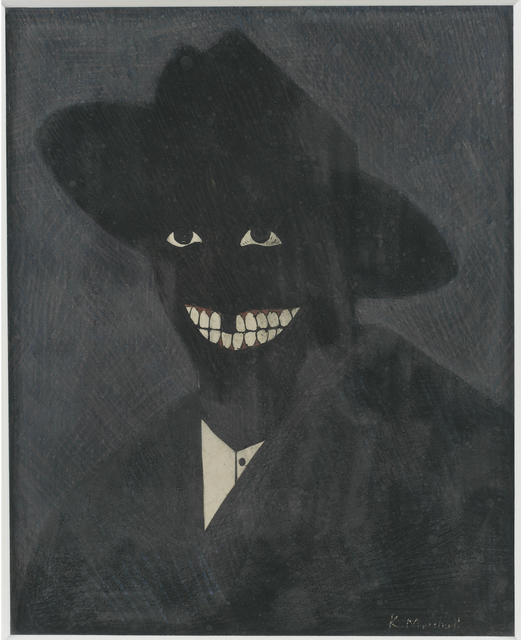
Using acrylic paint or egg tempera, KJM colors his figures’ skin with incredibly rich dark tones; they appear almost pitch black. That’s part of what Marshall is trying to achieve and he makes that explicit in one of his most striking images which recalls Jim Crow, the racist and widespread caricature of black men that emerged in the 19th century.
A Portrait of the Artist as a Shadow of His Former Self recalls fear (something lurking in the shadows), erasure (overshadowed identities and voices), and suppression (people cast into the shadows). People tend to be afraid of shadows and afraid of the dark because they don’t know what could be hiding. There’s discomfort, anxiety, and suspicion. These unpleasant feelings are born from and fuel prejudice and discrimination.
The artist as his former self suggests the artist has undergone a trauma. Or his former could allude to the fact that he’s no longer alive. That others’ unjust hatred towards him buried him deep. He is former, not present or future. There are layers upon layers of metaphors to uncover.
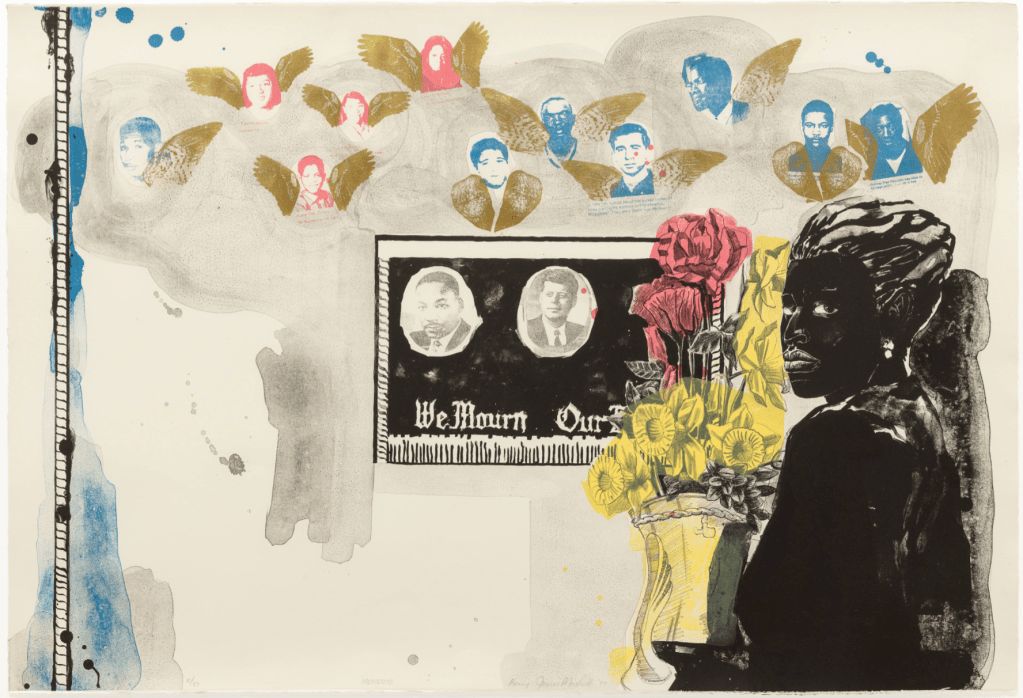
These paintings are visual eulogies for lives lost. They show grief, memories, and an overlooked, devalued culture. They’re reminders of Black loss at the hands of white violence. In Untitled (Policeman), KJM puts forward the cognitive dissonance of being black and being a cop. Being Black and Serving Blue. In other works, he appropriates imagery from art history, replaces white bodies with Black ones in an effort to disrupt the traditionally white art historical cannon.
Memento (1997) via sfmoma.org
KJM’s paintings stop you in your tracks when you’re walking through the museum galleries. If not for their striking hues, then for the way their figures look at you, urging you to pay them attention.




 A Place for Words