and just when you needed
yourself the most,
the mirror didn’t look right—
the dusty patina cast a veil
shrouding your face in ink
dark as forever’s oblivion
like the finale of a film roll.

the negative space
you now inhabit
surrounds a pale tracing—
lines too frail to bend
into a crutch
to hoist yourself up
over the penitentiary wall.

and just when you needed
yourself the most,
you didn’t know where
to find yourself amid the mess—
slumped in the corner,
sprawled out across the knotted wood
of a buckling floor
you swore you'd just repaired.
what's not getting through to you?

can't you see i'm trying
to seep through?

an apparently impenetrable membrane;
a cellular misunderstanding i guess.

an iron curtain you refuse to tear down.
are you blind to the divide?

it's splitting me in two
unequal parts,
fragmented shards.

it's all
broken up
to no avail.
There’s something really beautiful about people who fall into art as a life path. Annie Lee (1935-2014) became the artist she is recognized as today after a series of hardships beat against her door. After losing two different husbands to cancer and later her son to a car accident, Lee devoted herself completely to art although she wasn’t new to the craft. She had been painting since she was a child, winning an art competition at the age of 10, and even being offered a scholarship to Northwestern. She chose to dedicate herself fully towards motherhood and family instead.
Lee didn’t formally pursue art until she was 40 years old! It just goes to show that age is not a determining factor in career success, genuine passion, and admiration. She had her first gallery show at age 50. All around (and evidenced through her interviews), Lee is a very down-to-earth, humble woman.
In addition to her impressive artistry, Lee was philanthropic. She donated heftily to the Tom Joyner Foundation, which works to enrich Black Americans’ education by fueling programming that empowers them to attend HBCUs. I go so far into her background because I thoroughly believe that knowing the motivation, context, and intricacies of a person’s life makes their art that much more impactful.
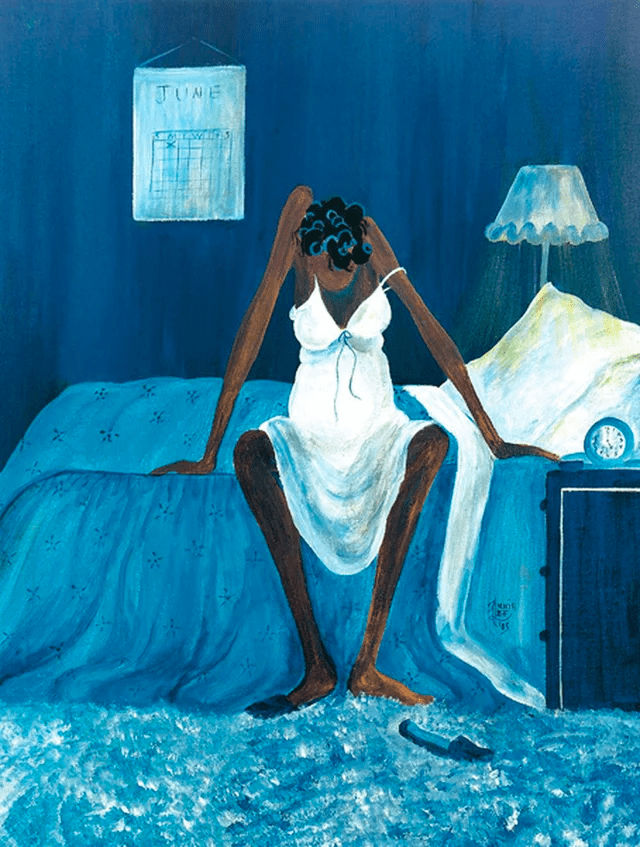
Lee painted Blue Monday, inspired by the time in her life when she was working as the chief clerk at the Northwestern Railroad. At first glance, I’m immediately reminded of Picasso’s blue period and the influence color has on our perceptions of imagery. We connote blue with sad. A common quality among Lee’s paintings is that she chooses not to depicts the facial features of her figures. Instead, viewers need to read body language in order to extract what the person is feeling. Lee makes that pretty easy for us
Blue Monday is relatable for just about all of us. It is about exhaustion. It is about that feeling when your alarm goes off early in the morning, your eyelids flick open, and your flooded with thoughts. Your dreams melt away and you’re reminded of your responsibilities. How you have to get to work soon. How you have all those meetings today. How you have to cook and clean tonight. How it will begin again tomorrow.
I love the shading in Blue Monday. The whole painting has this really soft feel. From the meadow-like fibers of the carpet, to the streams of light emanating from the lamp to the cascading comforter and wrinkled nightgown. Everything is cast downward. An early morning that has yet to rise. A woman that has yet to rise.
I believe that the painting carries different implications in that it centers a Black woman. We can also consider the particular pressures that Black women face and the exhaustion born from that experience. There are privileges that Black women are not afforded unlike their White counterparts. Generally speaking, White women are able to get away with more. Their shortcomings (showing up late to work for example or being cranky due to exhaustion) are not attributed to their race. (Maybe to their femaleness though…)
I look at Blue Monday and I am reminded that many of us dread mornings. Maybe we wouldn’t if we didn’t live in a Late Stage Capitalist society that necessitates oftentimes boring and draining work in order to survive comfortably. It also gives us space to acknowledge our pain. Our unique pain as well as our shared pain. What it means to undergo a trauma and keep going. Because what else can you do?


 A Place for Words