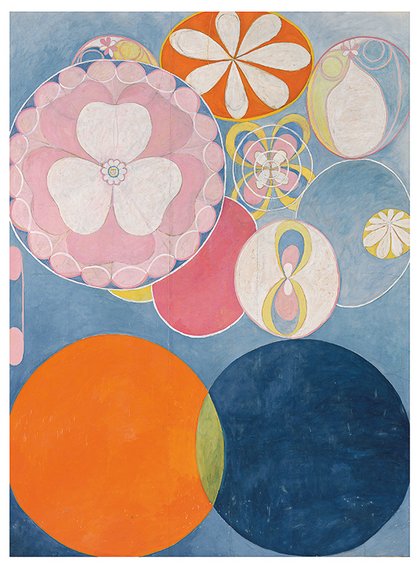
Swedish artist Hilma Af Klint is a perfect example of how male artists dominate the art historical cannon. While Russian painter Wassily Kandinsky is often considered the pioneer of Abstract Expressionism, Af Klint was creating in the style for years before him. It’s only until fairly recently that she’s been of focus.
I think Af Klint was incredibly ahead of her time. This sort of colorful abstraction was unprecedented (unless of course, there are other non-Western artists that have been veiled by mainstream Art History’s centralization of European/American artists–which would not be surprising). Af Klint was an imaginative and profound spirit. An apt word to describe such a mystified, spiritual character. She was heavily involved in women-occupied spiritual spaces. In a time when such thoughts and practices were deemed nonsensical and even blasphemous, she and her “friends (let’s be real, there had to be some sapphic stuff going on there), were preoccupied with these philosophies.
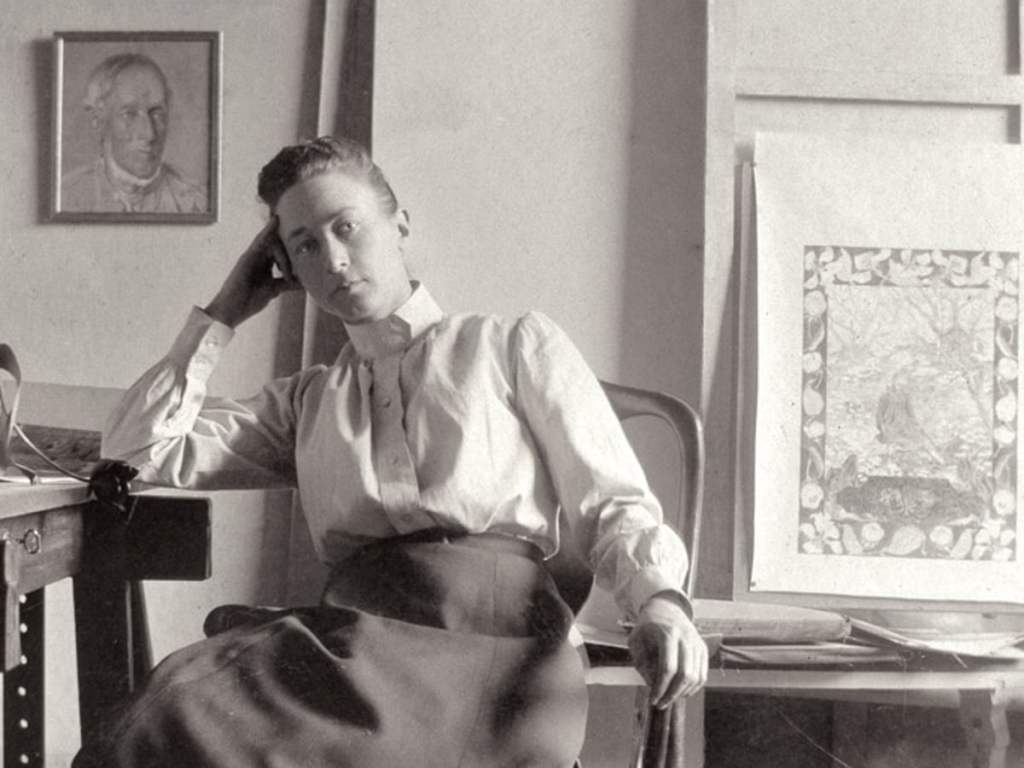
Af Klint became an active member of the Spiritist Literature Association–of which there is very little documentation. It’s even documented that when her sister passed, she took part in seánces and attempted to communicate with her. This woman was unapologetically curious about greater meanings and connections with otherworldly phenomena.
This fascination vividly shines throughout her oeuvre. It’s clear upon looking that the work’s biomorphic shapes connote nature, but they also ethereal and somewhat feminine about them. In The Ten Biggest, No 2, her majority pastel color palette is soft to the eye, as are her rounded shapes. The Venn diagram at the bottom makes me think of the overlap between the corporeal and the spirit. The earthly and the divine.
I was lucky enough to see Af Klint’s solo exhibition at the Guggenheim back in 2018. Most of her pieces are massive. It lends to their immersive qualities. It feels almost as if the composition surrounds you. You’re a part of this world she’s constructed. Or rather the world she’s reflecting back at you in new light.

Her work is the type that you can gaze at for hours. Okay, maybe not hours, but a long time. The interplay between forms, their complementing colors, their gentle shapes–all of it elicits this sense of tranquility. In fact, her work does a lot for the senses. It’s pleasant on the eyes. I imagine it’s smooth to the touch (don’t try unless you’re prepared to be banned from a museum for life). And if it were to make a sound, I think it would be that of a theremin. Something rather ethereal.
Some of her forms resemble eggs or cells. Genesis. A natural rebirth, or a respite from the industrialization of contemporary society. Her paintings feel hopeful. That we’ll recognize our humanity in this enduring life cycle, during which we exist only temporarily. Or do we? Someone devoted to the spiritual, as Af Klint was, may argue otherwise.
When artists create these sorts of serene artworks, I can’t help but wonder if they’re channeling that peace within themselves or they’re trying to find it. Was Af Klint portraying the world as she saw it? Or was she depicting an ideal world?


 A Place for Words