
Helen Frankenthaler has been one of my favorite artists for years and I honestly struggle to answer why when I’m asked. I’m sorry, Helen! I really do love your work. Although the Manhattan-born artist died back in 2011, her legacy lives on. Her artistic influence is undeniable. Her colors, her forms, her application of paint permeate even today’s art.
Anytime I see her larger than life canvases, I’m magnetically drawn to them. Just yesterday, another art history major friend and I were discussing masculinity and femininity in art. Of course this is a binary and can be subjective, but I find Frankenthaler’s art to be deeply feminine, not just because she was a woman.
In Flirt, for instance, the warm, pastel tones and floral-esque forms recall Springtime’s blooms–which is often associated with femininity. The rose like a vulva, the floral aromas like pheromones and perfume, the curves of soft petals like the hourglass of a woman’s hips. Even the paintings name carries this romantic idea. Do you also imagine the soft batting of eyelashes, downcast eyes, and slight smile when you think of flirting?
Frankenthaler used oil paint in such a unique way so that it seeped into the canvas. There’s something delicate yet sturdy about it given the canvas’ structure. The canvas itself becomes inseparable from the painting.

Frankenthaler was a member of the Ninth Street Women, which also included Lee Krasner, Elaine de Kooning, Grace Hartigan, and Joan Mitchell. These four gave birth to what we know as Abstract Expressionism; although they’re often overlooked in favor of their male contemporaries. Pollock, Rothko, Willem de Kooning, Franz Kline, and others. Classic… However, these women were included in the prominent 9th Street exhibition, proving that their prowess rivaled that of men.

Frankenthaler’s remarkable talent secured her place as a member of the New York School, a group of avant-garde artists at the cutting edge of this new form of expression.
The thing I love about abstract art, and Frankenthaler’s in particular, is that it is completely up to interpretation. There are no discernible figures to anchor down context. Unless you’re familiar with the artist’s life, motivations, or other factors at the time of creation, you’re looking at nothing but gestural shapes, brushstrokes, and colors. Your interpretation is just as valid as the person’s next to you. Better yet, your interpretation is just as valid as a highbrow art critic’s who uses their degree and experience looking at other pieces to convince you of their comprehensive knowledge.
We bring our own meanings to an abstract painting. We see what we know. What we’ve been through. What we like and dislike.
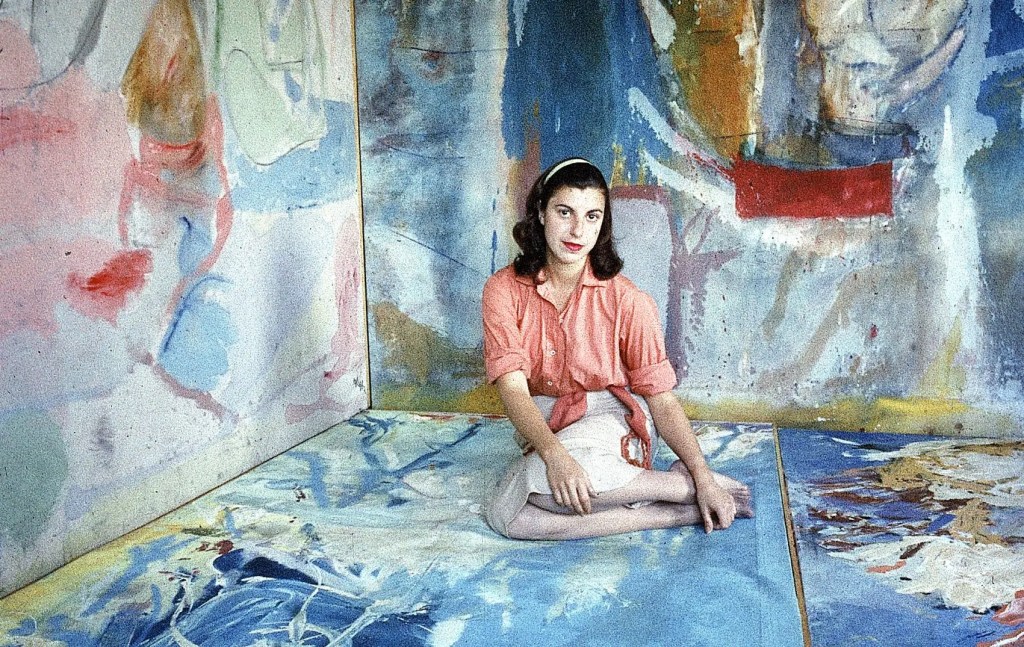
Frankenthaler painted Flirt towards the end of her life. I find it to be a beautiful culmination of a career spanning nearly six decades. She was never afraid to get messy. Even though some of her works may appear chaotic at first glance, there’s something very put together about them. She wasn’t flicking paint like Pollock. Or creating huge blotches like Motherwell (whom she was married to for quite some time). Anyone can see the care she pours into her work, literally pours.
Flirt evokes this sense of calm. The sky blue around the edges juxtaposed with the soft pink makes me think of the evolution of the sky as it nears night. This painting is the product of someone nearing the sunset of her life. It is a final ode to the thing she loves. A thing she helped to change the course of. A thing that makes people stop and stare. Even if they find it to be nothing but random brushstrokes, they still look.




 A Place for Words